A city trip capsule solves for changing streets. A cruise capsule solves for changing versions of the same day: breakfast on a moving ship, a few hours walking a port town in real heat, an afternoon back on deck, and some nights a dining room that expects more than shorts and a tee. The same range problem a multi-city Europe trip creates shows up here too, just compressed into one vessel instead of three cities, which means the pieces have to flex harder, not just pack smaller.
The math matters more than usual on a ship for one practical reason: global cruise passenger volume climbed to a record 37.2 million in 2025, according to the Cruise Lines International Association’s 2026 State of the Cruise Industry Report, and a meaningful share of those travelers are packing for the format for the first time. A first cruise is also the trip most likely to get over-packed, because nobody has yet learned which of the three daily modes, sea day, shore day, dinner, actually needs its own outfit and which ones can share.
Why a cruise splits into three problems, not one
A land trip capsule usually only has to solve for climate and formality drifting slowly over a week or two. A cruise compresses all three registers into a single day, most days: casual on the pool deck before lunch, considerably more put-together for a few hours in port, and for at least one or two evenings, dressier than either. The same core-colors-first approach that keeps any capsule from becoming three unrelated wardrobes is what makes this actually solvable in one bag instead of three.
White or ivory, navy, and one warm accent, coral, rust, or a bright citrus. White and navy read as put-together in a dining room and cool enough for a deck at noon; the accent color is what keeps four days of the same three neutrals from photographing as one flat block.
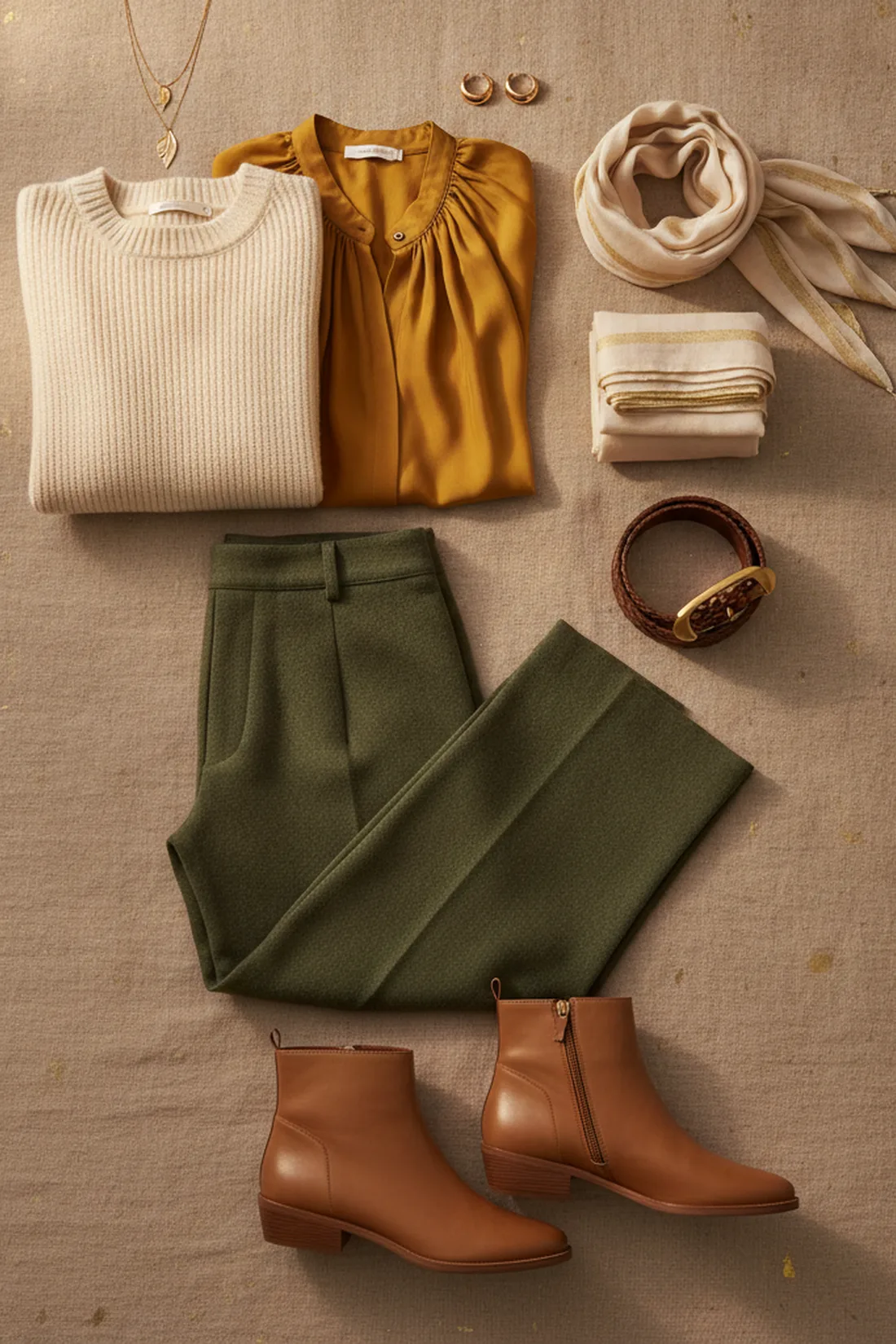
Image: Aurea studio.
The worked example: 8 pieces, 21 outfits, one bag
Here is a real 8-piece capsule built for a typical seven night cruise, sized to leave real room in a carry-on for the swimwear and shoes that do not enter the count.
3 tops (a breathable tee, a linen-blend camp shirt, a silky going-out cami), 2 bottoms (white shorts, black wide-leg trousers), 1 dress (a jersey wrap dress), 2 layers (a fine cardigan for chilled dining rooms, a packable wind jacket for open-deck days).
Start with tops against bottoms: 3 tops times 2 bottoms gives 6 base pairings. Each of those 6 can be worn three ways, on its own, under the cardigan, or under the wind jacket, which multiplies the count to 18. The dress adds 3 more the same way, worn alone, under the cardigan, or under the wind jacket, for a total of 21 outfits from 8 pieces.
One swimsuit and one cover-up round out the bag without entering the multiplication, the same way shoes stay outside the arithmetic in a home capsule: they finish a specific part of the day rather than changing what the rest of the outfit is. Pack one comfortable walking sandal for shore days and one low heel or dressy flat for the dining room, and the shoe count stays at two for the entire sailing.
Solving formal night without packing a formal outfit
Formal night is the piece of cruise packing that talks people into overpacking, because it feels like it needs its own dedicated outfit. On a typical six or seven night mainstream sailing it happens twice, Royal Caribbean’s own structure for that length of cruise, for example, runs two formal nights, one early in the itinerary and one toward the end, and most lines follow a similar pattern even where the dress code itself has softened.
Use the jersey wrap dress you already packed, not a new garment. Add the going-out cami's earrings, a heeled sandal instead of the flat, and the cardigan swapped for a silk wrap or scarf if the room runs cold. Two formal nights, one dress, two different sets of small additions, and nothing extra taking up bag space for the other five nights.
What actually earns a spot in a cruise capsule
Three tests matter more on a ship than they do on a normal trip. Does the piece survive humidity and salt air without wilting, a ponte knit or a jersey holds its shape through a muggy port afternoon in a way a stiff cotton often does not. Does it dry fast if it gets splashed, sprayed, or rained on during a tender ride to shore. And does it still look considered after being folded into a packing cube for a week, since cruise cabins rarely have the closet space or the ironing access a hotel room does.
Fabric choice carries most of that weight. A fine merino or a jersey blend resists creasing far better than linen does, which is exactly why it earns a spot here even though a pure linen shirt might look better in a single photo on day one. A cruise capsule is judged over seven days of folding and repacking, not one.
What to skip
Skip a second formal outfit packed “just in case” the first one does not feel special enough; the formula above solves both formal nights from one dress, and a second dedicated dressy piece is dead weight for the other five days. Skip a heavy structured bag for shore days, since a packable tote that compresses flat does the same job on the one or two days it is needed and takes up none of the space on the days it is not. Skip a third pair of shoes bought for one specific excursion; a genuinely comfortable walking sandal and one dressier flat cover the whole range this capsule is built for.
The one mistake to avoid
The single most common cruise packing mistake is designing the bag around the ports instead of around the three daily modes. A capsule built as “the beach port outfit, the city port outfit, the ruins port outfit” produces several narrow wardrobes that do not talk to each other, the same failure a multi-city trip capsule runs into when it is built city by city instead of around one coordinated range. A capsule built around sea day, shore day, and formal night, instead of around individual ports, covers any itinerary with the same eight pieces.
Image: Aurea studio.
Checking the final look
Once the capsule is packed, the check that matters on board is the same one that matters anywhere else: does today’s pairing look chosen, or does it look like whatever surfaced first in the packing cube. A coordinated color story makes that easier to get right by accident, but a long sea day still makes it easy to grab mismatched pieces without noticing until the dining room mirror.
This is exactly the kind of check Aurea is built to run from a cabin mirror. Photograph the outfit, and it scores color harmony, fit and proportion, and occasion match in about thirty seconds, the same read whether the moment ahead is a tender ride to a port town or the second formal night of the week. It will not pack the bag for you, but it will tell you honestly whether the outfit you built from it is actually working before you leave the cabin.
Questions, answered
How many formal nights should I actually pack for?
Two is a safe default for a typical six or seven night mainstream cruise, since that is the standard structure lines like Royal Caribbean build their itineraries around. Check your specific cruise line and sailing length before you pack, since shorter sailings often carry only one and some lines have replaced the formal dress code entirely.
Can one dress really cover a shore excursion and a formal night?
Not the same dress worn the same way, but the same dress styled two different ways, yes. A jersey wrap dress worn with sandals and a tote is a shore day outfit; the same dress worn with the going-out cami's earrings, a heel, and a wrap is a different outfit entirely, which is the whole point of building a capsule instead of two separate wardrobes.
What if my cruise has more port days than sea days?
Shift the ratio toward the breathable tee and the shorts rather than the dress and cardigan, since a port-heavy itinerary spends most of its daylight walking rather than lounging. The capsule below still works; you are just leaning on different pieces within it more often.
Do I need different packing for a cold-weather cruise, like Alaska or the Baltics?
Yes, the color story and the two layers stay the same in principle, but swap the wind jacket for a genuine warm layer and the linen-blend shirt for a heavier knit. The math (base pairings times layer states) does not change; only which fabrics fill each slot does.